Sunday

Sacred Rose: The Soul’s Path to Beauty and Wisdom – Book Review.


Mara Freeman  is already known in Druidic and Western Magical circles as the founder and director of the Avalon Mystery School and her life’s work has been to offer seekers on the path a profound route into their personal quest. Her earlier books, Kindling the Celtic Spirit and Grail Alchemy, are two of my go-to resources for finding the depths of mystery in this world and in others. I was keen to read her latest book, Sacred Rose: The Soul’s Path to Beauty and Wisdom. Filled with magnificent colour illustrations, and with rose-centred meditations which can be undertaken to fully illuminate the deeper messages and learning within the book, this book will delight any person on a spiritual quest.


I knew, as I began to read Sacred Rose that it would be a work of scholarship. Freeman’s careful research is combined with an attractive writing style that is never difficult to read, and she offers the sacred rose to us on two amazing levels, carefully covering both the outward and inward story of the rose. Throughout the book, we journey through historical fact, literature, sacred religious thought, legend and myth to find roses at the very heart of humankind’s longing to experience the mysteries. But at intervals, we are asked to stop, to meditate, following a visualised inner journey to take us into an aspect of sacred rose.


Freeman begins with the connection between roses and goddesses, especially Isis, Aphrodite and Venus. She then examines the relationship the medieval church had with the rose, especially though Mary, the Mother of Christ, who is often portrayed in a rose garden. She offers refreshing insights into the Rosary and the amazing rose windows in cathedrals across Christendom.


Looking across the ancient world, Freeman compares the rose to the many-petaled lotus,  explores its hermetic connections, and its honouring in the Arabic world, both Islamic and Zoroastrian.


The story of the ‘rosy cross’ and the Rosicrucian movement takes us forward to the special links between roses and alchemy, the Order of the Golden Dawn, the Tarot, and the more recent resurgence of interest in the sacred world. 


Freeman uses poetry to illustrate this. From Roman writers  to  Danté’s ‘celestial rose’, to the 13th century Sufi poet, Rumi, to Yeats and Elliot, she demonstrates how the rose is a portal leading us closer to the mysteries of life. 


The core  message of the book is how the reader can enter the ‘language of the rose’– how the Mystic Rose…also blooms within the individual soul. This is not achieved by the physical act of reading the book, thoughtful commentary though it is, but through the work the reader will do around the text, including using that combination of concentration of will and the creative imagery of the mind to walk into the world of the meditations that accompany the text. These allow a personal journey that certainly connected me to my deepest inner parts, and from there, to moments where I felt able to reach the spirit of the rose. My intention is to return to each meditation time after time, reaching deeper into the
magic.


Freeman sets out methods of attaining this beauty and peace, including the use of rose essences and by creating a sacred space which would include the perfection of a plucked rose. 


You can purchase this beautiful book here


THE MYSTERY OF PAVILAND CAVES: AN ANCIENT SHAMAN OF WALES


an artistic representation of the buriel of the 'red lady'

I like to believe that right here within the British Isles, we have traditions in shamanic work that go back as far as the very first people to walk these lands…and that’s long before the British Isles were disconnected from mainland Europe. One of the things I love to do is listen to the land to hear the story our ancestors have left us. Like many others, I’m searching for a personal understanding of how the ancient people accessed and used the same spirit world I’m able to ‘walk’ into today. 
In Britain, we hold one of the most wonderful discoveries demonstrating just how spiritual these ancient people were – the oldest known ceremonial burial site yet found in Western Europe.

Just under 200 years ago, a doctor called John Davies was exploring the cliffs near Worm’s Head on the Gower in South Wales. He climbed up to a small cave called Goat Hole, where he came across a skeleton. He quickly informed his friend William Buckland, an Oxford professor, who thought himself to be an expert on such things. He came to have a look at the bones in the cave, afterwards writing a description…

”I found the skeleton enveloped by a coating of a kind of ruddle…which stained the earth, and in some parts extended itself to the distance of about half an inch around the surface of the bones ... Close to that part of the thigh bone where the pocket is usually worn surrounded also by ruddle, about two handfuls of the Nerita littoralis [periwinkle shells]. At another part of the skeleton, viz in contact with the ribs, forty or fifty fragments of ivory rods, some small fragments of rings made of the same ivory and found with the rods ... Both rods and rings, as well as the Nerite shells, were stained superficially with red, and lay in the same red substance that enveloped the bones."

Early photo of William Buckland
Buckland believed this to be a Roman prostitute, which he named the ‘Red Lady of Paviland’ because of the ‘ruddle’ (actually a red ochre powder), covering the body, now known to have had huge significance in early times. Buckland assumed a red burial meant ‘profane’. It actually meant ‘sacred’ to the people who used it.

Buckland was also wildly in error over the age and sex of the remains. This person wasn’t Roman, but rather, the earliest Homo Sapiens skeleton we have ever found in the UK. And although still affectionally called the Red Lady, he was a tall, slender man in his early twenties.

Buried with him were shell necklaces, flints, stone needles and animal bones, including a mammoth’s skull. But most important of all, for me, are the mammoth ivory ‘rods’. These seem to be fragments of a beautifully carved wand. They were found together over his ribs, suggesting that this wand, ritually snapped into pieces during the burial ceremony and placed over his heart, was a shamanic tool.

Because of Buckland’s misunderstanding of the importance of the find, we’ve lost quite a lot of the remains,  including the mammoth skull, which went missing in the nineteenth century. However, the human skull was missing even at that earliest point and no one can work out whether it was simply taken by animals or if there is a more interesting reason for its absence. I cannot help linking this man’s sacred interment minus his head with the wonderful story of Bran’s oracular head, as told in the second branch of the Mabinogion, an early Welsh myth. 

I’ve been to the Goat Hole, where the Red Lady was found. To reach it we scrambled from the farmland above the cliffs down a gully towards the sea. Pink and yellow tufts of flowers grow out of the cliffside and there’s a constant sound of water trickling, accompanied by the gulls and the shush of distant waves. But the gully is rightly named ‘the devil’s path’. It is steep and difficult. If you don’t watch your footing, you can slip on scree as precarious as ball bearings, or twist an ankle on the loose and wobbly boulders.


Towards the bottom, the path narrows to a foot’s width, leading to a drop, the height of a man, onto the flat slabs of rock below. Here, the wind comes off the sea with a fast, sharp edge. Even at the vernal equinox, the tide is relentless, giving you bare hours to explore. The flat limestone expanse also needs care – it’s a mass of razor edges, like the sharp scales of some marooned sea-monster, ready to cut hands or knees. Between each slab there are gaps as wide as a stride. But it’s worth the risk of a scraped knee, because the rock pools are wonderful, a miniature world of sea creatures with seaweed resembling fresh lettuce and woodland ferns. We were on the coast of the Bristol Channel, but when the Red Lady was put to rest, his grave would have been 70 miles inland, overlooking a plain ripe for hunting and gathering, and, with a bit of a trek, fishing.

To reach the Goat Hole, we had to scuttle straight up the cliff side. There were ten of us on this outing, and we managed to squash into the cave together. We wanted to honour what happened here thirty-thousand years ago.

One of our party lay in the cot-like area where the Red Lady had been found. In the half-light, her still and silent body transformed for us, and we were able to step back in time. I was easily welcomed into the otherworld. The rocks were resonating with energy – I could palpably sense the spirit of the cave. Quietly, each of us stored our own impressions.

At the bottom of the cliff, at sea level, is a larger, more geologically impressive cave. We called it ‘the womb’, because of its internal structure and the tenor of our journey within it. The cave mouth gapes as you walk to it, but from a distance, it’s very like a woman’s vulva.

At the mouth of the cave, we all took off our clothes, leaving them folded in a dry spot. If we were to go into a womb as hallowed as this, we wanted to do it in full, natural reverence, as children of the earth. 

The first chamber is elongated with an uneven floor and a raised ledge to one side that leads away into darkness. One by one, we crawled onto this narrow ledge. Its outer edge was rounded and slippy, and a slick coat of slime and seawater, as precarious as wet ice, covered both ledge and wall. Below, the lower level was deep in icy water, trapped after the tide’s retreat. We inched our way in, unable to grip anywhere or trust the next move.

Some of us walked upright, but at a wearisome pace. Most of us, including me, crawled steadily away from daylight. Each movement seemed to take me an hour, as if my muscles were being glued together, and all the while, the booming waves echoed in my head. I crawled on and on, my knees and palms sliding against what felt like the very mucous membrane of the cave, until all light was lost. I was like a child in a dream, letting the earth take me into itself.

The middle section of the cave forms an hourglass, which opens into the final chamber, the rounded womb of the cave. The air here was chilled with an edge of salt, but it was slightly higher ground, with a dry shingle floor which was comforting for our bare feet. The place certainly felt like a place of safe lodging after a hard journey. There was total darkness this deep into the rock, but if we stood directly under a certain spot we could perceive at a far distance, a circle of dull light. At first I thought it was a crystal, embedded in the roof of the cave, but then I realised. It was a funnel, leading to the clifftop. 

We held hands in silence. Quite naturally, we began to chant, some singing tunelessly. This went on for a long time, until we left the perceived world altogether. As we finally came back into normal reality, one of our number exclaimed. “something’s cutting into my foot.” He bend to retrieve the item, and held it all through the perilous journey into the light. The thought in our heads, as we returned from the deeply profound moments together in the womb cave, was that of birthing, of coming out into a space newly transformed. I was sure we would all see the apparent world differently now.

Selection of found prehistoric flints
After we’d pulled our clothes over damp skin, we examined what our friend had brought out of the womb cave. It was a spear tip, perfectly knapped in flint. A gift from the spirits of Paviland, who have watched over the dead and the living for eons. 

We picnicked right there on the lip of the cave, looking out over the Bristol Channel.  The sea was like a steel mirror. A small fishing boat passed off shore and someone waved. We all waved in turn. 

 Later, back home, as dusk fell, we enacted the death of the priest-shaman, imagining how, as he was dying, he might have passed on his gifts to certain among his people, telling them which of his sacred artefacts were to be interned with him. We dramatised his burial, each playing our part, feeling our way back to bereavement 32,000 B.C.E. 

Finally, we journeyed individually to the beat of a single drum. In my journey, I returned to the Goat Hole. On my climb up the cliffside, I passed an elf-like creature who beckoned to me. But my spirit ally warned that this was a tricksy spirit and to keep journeying onwards. I finally reach the cave and ducked inside. There, sitting just where the light fell upon him, was a colourful figure, rather like a jester, who described himself as the Story Maker. He asked me to document my time at Paviland, and what it meant to me. 

When I returned, I furiously wrote a description of both my journey with the drum, and our physical journey earlier that day. The Story Maker had compelled me to think again just how essential this was. As I wrote, the entire day became more and more real to me, as if I was living it through again, in even more ‘mindfulness’ than I’d had at the time. When you’re travelling in a group, you’re bound to become one of them in so many ways…concerned for anyone who’s finding it tough…laughing at someone’s clever quip. But during my shamanic journey up the cliff and into Goat's Hole, I was alone, and every sensation, internal and external, was acute.

The writing made an internal shudder pass through me. I had been to the place where, over 30,000 years ago, people had buried, with honour and dignity, and in the presence of spirits they had called as witnesses, an early shaman of Britain. I feel honoured to have been part of that continued rediscovery.


A version of this blog first appeared in Indie Shaman Magazine in 2017 https://indieshaman.co.uk


Tuesday

Walking the Golden Road: on Top the Preseli Hills


“Everywhere you feel the presence of the megalithic tomb-builders, of the iron Age warriors who piles stones for the great hill forts and of kindly and absent-minded Celtic saints.”

I can remember hearing the words of Winford Vaughan-Thomas on the radio when I was little, and he was already old – he’d been a decorated 2nd WW correspondent – but his first love was the Welsh countryside, and above, he’s talking about the Pembrokeshire Preseli Hills, locally called Mynydd Preseli. 

Myndd means mountain, because the Welsh have a flexible view of what makes a mountain. If the place is high and fairly inaccessible, rugged and wild, often lost in cloud and offering breathtaking views to climbers, that’s enough to call it a mountain, even if it doesn’t quite make the obligatory 600 metres.

Vaughan-Thomas had a love of the famous ridgeway walk called the Golden Road, which runs along the spine of the Preseli Hills, Anyone who has a passion for the ancient past, fabulous walking or stunning views, would love it. 

A month ago, I blogged about a Summer Solstice celebration we held at a Pembrokeshire stone circle called Gors Fawr. While were enjoying our picnic, some of the company told me they planned to walk the Golden Road. 

“It’s seven miles,” I complained. “Too long for me.” But as I gazed up at the ‘Dragon’s Back’, one of the possible quarries from which stones were believed to have been taken to Stonehenge 4000 years ago, and Carn Bica, where a second Neolithic stone monument stands, I just couldn’t resist. Both of these would be on our route. 

The Dragon's Back 
We set out on a Sunday in late June at 10am. The weather was perfectly awful, a misty drizzle that hid the path ahead. “Should we do this,” I asked. “Aren’t you supposed to avoid mountains when the mist comes down?”

Everyone reassured me. This spinal road is wide, sometimes almost half a mile of flat high moorland, with a marked path. No danger of getting lost or falling off the edge. The most treacherous thing would be the boglands, areas of soggy ground that can trick you if you do stray from the designated path.

And so the seven of us shouldered our backpacks and set out from the village of Rosebush, with Foel Eryr, or ‘Place of the Eagle’, at our backs. Eagles are no longer seen in Wales, but buzzards and red kites were gliding overhead, and they are majestic enough for me. At the summit of Foel Eryr there is a Bronze Age burial carn, marking, perhaps, the resting place of men and women who were important to that clan or tribe. We turned from that summit to the Golden Road and were soon walking alongside the northern edge of the Pantmeanog Forest, and as the pine forestry cleared, we looked across to the highest point in the Preselis, Foel Cwmcerwyn. Half hidden in the mist, it’s 1,759 feet high, making it a brilliant subject for a film like The Man Who Went up a Hill and Came Down a Mountain. It really would only need a few more metres of rock.

http://www.themodernantiquarian.com/site/502/foel_feddau.html
The Golden Road may have been walked for 5,000 years or more. It was one of hundreds of high ridgeway trails which people and animals used to avoid the dense forests, impassible rivers and difficult and dangerous terrain at lower levels…not to mention unfriendly locals. Some believe the Golden Road was a trade superhighway, along which gold mined in the Wicklow mountains in Ireland was carried south east as far as Wessex…to the very place where Stonehenge still stands to this day. If you have ever visited the Dublin Museum, you will have seen examples of the Neolithic gold jewellery, that both men and women of high status would have worn on their special occasions, and the Britons wanted to trade for some of that, I’m sure. 

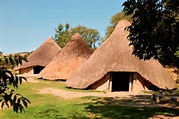
We ate up the miles, walking mostly on flat high ground. As the mist began to lift, we could look left, to the south, and there was Foel Feddau, or Bald Grave, a high trig-point with yet another Bronze Age buried carn. Looking right, we tried to make out Castell Henlyll, a large Iron Age fort sitting high up some miles to the north. Castell Henlyll has been rebuilt to closely resemble the original settlement where the Celtic Demetae tribe lived 2,000 years ago. In fact, it’s unique in Britain – the only reconstruction on an exact Iron Age site. It’s well worth a visit. Not only have they built several perfect roundhouses, including the chief’s impressive dwelling, but they run events, for children of all ages, day workshops where you can train as a warrior, learn woodturning or help build a wattle and daub wall. We love going there, and recently we gathered near a roundhouse fire to hear Robin Williamson play, sing, and tell tales from bygone ages.

After another hour’s walking we stopped for water, leaning on a line of rocky outcrops called the Cerrig Marchogion…Rocks of the Knights. In a grassy cwm below, the myths and legends of Wales tells us, King Arthur fought a bloody battle with a fierce and enchanted boar caller the Twrch Trwyth. They needed a comb which he held in his stiff boar hair to complete the tasks they had been given by a giant. We were leaning against the gravestones of the slain knights. Of course, these are natural outcrops, but I could certainly understand why legend tells that this was an ancient graveyard, high in the hiils. 

All at once, the mist dissipated and the sun shone golden on the valleys below. We gazed down, trying to make out Gors Fawr, the stone circle where we had spent the Summer Solstice in balmy weather, and planned this walk. 

Carn Bica
Finally, we reached the rocky tor of Carn Bica. We sat to eat a picnic, but were keen to move on, because we could see Bedd Arthur, a ring of stones in the shape of an eye – or a longish horseshoe – or a boat – or, more interestingly, the shape of the inner bluestone circle at Stonehenge. It’s only one of many places said to be the grave of King Arthur, but Arthur lived around 600 CE while this monument dates back to Neolithic times.

Just below it is Carn Meini, its bluestone rock eroded into jagged shapes that do look like a dragon’s back, it’s local name. For many years it was believed that the stones in the inner circle at Stonehenge were quarried here – a type of bluestone, the so-called ‘spotted dolerite’ – and if not quarried for that stage of Stonehenge, then certainly lifted by glacial action and taken close enough to the building site. However, this spotted dolerite is not the only type of bluestone found at Stonehenge. 
Close to the path’s end, we passed Foel Drygarn, a perfectly rounded hill rising out of the moorland.  It was tempting to digress from our path and climb it. There’s an early Iron Age fortress (around 350 BCE) with a double ramparts and ditches still visible. And right at the top are three Bronze Age burial carns. But we must have all been more than ready for the last two miles to the end, because no one took the diversion. I will do it, though, sometime soon! 

As we passed a final fir plantation, coming down towards Afon Taf, and the town of Crymch, we still felt like we were a inhabiting another world. We’d passed through mythological stories, enchanted lands, ancient history and remote but beauteous landscapes. Not once, along the seven miles, had we seen another human soul.  As we reached the cars we’d left at the far end of the walk, we could not have felt more content. All we needed to do was sit in the sun with a beer in our hands. So it was off to the Nags Head in Abercych for a final celebration.

Friday

Our Own Sacred Landscape; now in Indie Shaman


Our Own Sacred Landscape.


I went for a walk, one autumn afternoon. I wanted to sit and meditate, so I chose to go to ‘my place’. We all have one, I hope, even if it’s just a quiet corner of a small garden. At that time I was living in a suburb of Bristol, and ‘my place’ was locally
 called The Bowl; a six acre disused council tip, hidden behind a leisure complex. Sounds grim, but it was beginning to come back to life.

As soon as I entered the bowl, I knew something was different there. I could see a flock of what looked like finches, bobbing about from bush to bush. They had a scratchy, sharp song, but as soon as they were aware of me, they began to call their alarm. Chat-chat-chat…"


So opens my latest article of Indie Shaman, which was published in 
issue 51 available now (just £3.99!). 


It's the story of 'The Bowl', a wild  and forgotten patch of land in a busy, built-up area, not even six acres across, hidden between a Cineworld complex and a six-point roundabout.  It was less than a mile from the Bristol home we brought our children up in, but I only discovered The Bowl one day, I went looking for wild rose bushes.   


The article tells the tale of what happened next; how someone can get caught up in a whirlwind they weren't expecting. I contacted Avon Wildlife to ask if they knew there were skylarks, and indeed, also linnets, whitethroats and stonechats nesting and using this tiny patch of forgotten land. The Wildlife Trust they told me it was under threat from developers, and they were looking for someone to head up a campaign to save it. 


So began an eighteen month crusade that drew in neighbours, my son and his mates, my husband and, (of course), all the druids I knew. We formed a little group which had meetings with  local councillors as well as the Wildlife Trust, around the dining table. We gave talks, spoke on the radio, had an information stall in the local mall with boards full of photographs of butterflies, wild plants and trees. We started a petition and presented the thousands of signatures which we'd gained tramping the streets around the area to a council meeting. We were even on the local telly news.

With my friend Gail and the trees we 'guerilla' planted 


But what drew me to the bowl, was not a campaigning fervour. It was the fact I'd found a place I could consider sacred, and that felt all my own. I honoured one specific bush there, a lovely wild rose that grew proudly beside some everlasting peas. Her flowers were the colour of rose quartz and her leaves sparkled with a lime green gloss. Each time I want to The Bowl, I'd circle her thrice and talk to her. And she would answer me. I was working with a specific local goddess at the time, the Celtic goddess Rosmerta, and I knew the rose bush represented her. 


"The year had turned, and it was mid-summer again. I went to The Bowl, now definitely ‘my special place’. with my husband to hold a small, personal ritual. We worked around Rosmerta the wild rose bush, now the largest and loveliest rose in The Bowl.  Afterwards, we wandered around, in meditative mood, when I stooped suddenly, to examine what I thought was a bee, taking nectar from a grass vetch.


The artwork that is now at The Bowl
I was mistaken. I was looking at a spreading colony of bee orchids. We’d already found pyramidal orchids at The Bowl, but I’d never seen bee orchids before, and on this midsummer’s day it was the perfect discovery. My Rosmerta rose bush was thanking me for the effort we’d all put in."


How did it all end? Did we manage to stop the developers? Sorry, you'll have to read the Indie Shaman article to find out! This magazine is filled with wonderful stories with a theme of pagan, shamanic and mystic, so it's an excellent buy. Just go to https://indieshaman.co.uk/shamanism-magazine/ to find out more 


Monday

Coronations: A Ritual Crowning


The crown on Charlemange

A coronation is swirling around us in the UK even as I write this. Golden carriages are trotting along the Mall past cheering, waving citizens as a new king and queen go to be crowned. Although Charles acceded to the throne at the moment of his mother’s death, the coronation is the symbolic ceremony that marks his new role. Kings and Queens have been turning up at Westminster Abbey since William of Normandy hastened there; keen to get that crown on his head before someone else snatched it – or snatched away his life.
The ritual behind a crowning is meaningful, even for those who don’t believe in monarchy. As a lover of ritual, I’m at least respectful of other people’s need for ritual, ceremony, tradition and  pageant. All pagans who have read their Frazer know that the idea of ‘The King is dead –– long live the King!’ goes back a very long way indeed, as does the symbolic headgear worn to demonstrate that superiority, rule, and reign. 


The word coronation means the act or occasion of crowning - putting a crown on the monarch's head. It is a most universal ritual of governance, used all over the world in times gone by. In fact, its origins are pre-historic. 


In those past times, kings were far more common than they are now –– almost two a penny –– there were 800 kings in Ireland alone in the Dark Ages. And although it was understood that these kings were human, or at least had been human before the crown was  placed on their head, they often became far more than that.


In Egypt,  the Pharos were semi-divine and worshiped as gods. After their deaths, they were buried as gods, and still revered. 


the Copper Age Crown
I was interested to know just how far back the idea of wearing something on one’s head might signify one’s  dominion.  In 1961, a copper crown was discovered in a secluded cave near the Dead Sea. Dating to around 4000 BC during it  has  vultures extending from the top. It is breathtaking, although perhaps not quite as breathing as the crowns of Silla from the around the 6 century BCE and discovered in an excavation in Korean.


The crown of Silla
Until more recent centuries, crowns have always been ‘open’, as indeed are the paper crowns children wear in play. But in the coronation today, both crowns are enclosed, with an inner fabric area, possibly to help both the comfort of the wearer and the pomp of its look. 


Almost as soon as the Queen died, conversations started about King Charles's coronation especially its cost and meaning in this secular, finance orientated world. 
How big a state occasion should it become; should we invite dignitaries from around the world? Or those who dedicate their lives to good deeds in Britain? 


King Charles has asked for a smaller ceremony than Queen Elizabeth had but it seems to have grown like topsy despite this. It’s in progress as I write this, an extremely grand event with pomp and pageantry, colour, music, prayers, anointing, and vows to be made. 


As someone who understands how important ritual is to my own life, I can have at least some empathy with the idea of making this a big occasion – the touching and holding of symbolic artefacts, the anointing with oil (or spring water), the wearing of ritual robes. These things solemnify important occasions and fix them in the minds of those who undertake them. 

Saturday

The Journey to the Otherworld: A Way of Starting your Shamanic Path.


Glastonbury Tor Midsummer 2016

Ideas were swirling around in my head in the autumn of 1998 when I attended a series of workshops with the Celtic shamanic practitioner John Matthews. I’d read a lot of his books, and that of Caitlin Matthews, and had already tried to journey. 


I first experienced an ‘inspired visualization’ in the home of a Druid. There were twelve or so of us sprawled out on her carpet. I laid my jumper over my eyes and listened to her seductive voice describe an imaginary landscape, telling us to smell the scents and look around us. She called this ‘using our psychic eyes’, which, apparently, were open behind our closed lids. At first, thoughts kept getting in the way… do I look a prat lying here…is my bag of Chorizos good enough for the communal table? Bit-by-bit, I began seeing things that felt very real. I could feel the grass beneath bare feet, hear a skylark singing. Her voice faded away, and it was up to me what happened next. 


I wanted to learn more and so I turned to shamanism. I wanted to ‘journey over the rainbow bridge’ that would take me into an otherworld, and gain a deep connection with Nature, an understanding of what is outside ourselves and learn about Spirit. One of the first things John Matthews said on that day is “this will change your life”. I was there to learn, but even so, the thought that came to me was, “what rubbish that must be!” By the end of that weekend, I had realised he was right; journeying across the rainbow bridge into the otherworld changes your life in a phenomenal way.


That was 25 years ago. Now I use shamanic techniques regularly and with amazing results, which help me in my personal life, in ritual, and my creative work, too. 


I'm not recommending that you simply jump in without a guide, though.  'Baby steps' is a very good approach when thinking about investigating shamanism; it's profound, it's global, it's literally mind-blowing; it really does change your life, and it needs to be approached thoughtfully, steadily and with caution.  It's not a hobby, to be picked up lightly then dropped again. Once you've started, it's very hard to stop. There are some guidelines you should be careful to follow. Be warned –– then you can be fearless.


The first thing, perhaps, is to decide how you are going to access this amazing otherworld. Some say that you cross a 'rainbow bridge', others say you 'take a crystal path'. These are metaphors, of course, but some medium in necessary to get you into an Alpha Brian state so that you are no longer fully in the present world. 


I use drumming; others use chanting, dancing/spinning, or listening to a gong or didjeridoo. Some, of course, rely of drugs, but I have actually ever attempted that. I find drumming effective and useful. At some point, you should make (or buy) a drum (bodhran), but to begin, it's best to use a recording of a shaman drumming. These can be downloaded from the internet, or purchased as CDs. Chose the plainest; no speaking, and limited other sounds (such as birdsong).


You might try the website The Way of the Buzzard for more information on listening or creating drums. Play the drumming, not too loud, while you are either sitting comfortably or lying prone. Cover you eyes with something soft and dark. Allow yourself to relax, one muscle at a time. Focus on the 'song' of the drum, which is a constant note above the drumming. Allow whatever images you feel are arriving to form more solidly in your mind. Forget about the outside world, and 'see' with your psychic eyes. Watch the images unfold. These can be very varied; people see events, or shifting patterns, or 'a variety of 'still images' or a 'movie'; or hear, rather than particularly see, things. 


Choose the shortest drumming session for your first attempt. Note how there is a starting beat, then the fast drumming ( around 4 beats per minute, which is far slower than the 'rhythm' of your brain – this fast beat actually slows your mind). Finally you'll hear the 'call back' which is a different beat that interrupts your journeyings. Stretch and take off your 'mask' at that point. You are back in the apparent world, and ready to make a record of your first journey to find the song of the drum. Before you forget, note down everything that happened. Write down something of what you saw, heard, felt, etc, and any thoughts that occurred to you.


Find out more about that here 


You can read some of the records I've kept about journeys by clicking on any of the links at the SHAMANISM PAGE (Shamanism; The Crystal Path to the Otherworld) 


Tuesday

The Summer God of Love Oengus Mac Og


They say that Oengus Mac Og, the Irish god of love and inspiration, wit and charm, was a born liar. He could gab his way out of any tricky situation and gab his way into any advantageous one.


But if he was a trickster, it’s no wonder, because he was born of a trick. 


The Dagda, an Irish god so huge his club could not even be lifted by eight men, fell in love with Boann, goddess of the river Boyne, which flows past Newgrange in the northeast of Ireland. Boann was already married, but that did not deter the Dagda in his amorous pursuit. Naturally Boann fell pregnant and was terrified her husband would find out. So the Dagda caused the sun to stay still in the sky for an entire year, and when, at the end of what he though was a single day, Nechtan returned home, all seemed the same, except for a puzzling change in the foliage on the trees. 

On that one day, Boann had given birth to Oengus Og, and the Dadga had taken him away to be fostered in a good home.

I suppose his story really starts when he’s maybe fifteen — after all, it’s set in the smelly bedroom of an adolescent boy who wakes one morning to remember what seemed almost like a dream; the most beautiful girl had come into his room. From that day, in a love-sick fever, Oengus does not leave his bed, wrapt up in the dream of her. 

His foster mother asks him, ‘darling, what is wrong?’ But he can’t reply. 

His foster father comes to him; “Now, son, you’ve got to stop all this nonsense.’ But still he can explain.

Finally, they call the Dagda and to him, Oengus reveals the truth; he’s in love. The Dagda spends a year searching before the girl is found. 

Yewberry
Turns out she is Caer, or Yewberry, the daughter of the fairy king Ethal Anubal, who,with her 149 sisters, mostly wears the garb of swans. When Oengus arrives to claim his love, he has to pick her out from 150 white birds. But he knows her directly; she has a golden chain around her neck. He also transforms into a swan and they circle the lake three times before flying off to the Brough na Boinne. 

This was the ancient name for Newgrange, and it is said that it originally belonged to the Dagda, but when Oengus finally discovered he was his son, he decided to grab his inheritance. After all, his mother was goddess of the river that flows around this great edifice. He approached his real father, to ask if he could take up residence for a night and a day, and the Dadga gave his consent to that small request. 

Brough na Boinne –– Newgrange
However, the next morning, Oengus          refused to leave. Remember, that in old Irish, as in Welsh today, there is no indefinite article. ‘A night and a day’ would simply be ‘night and day’ and Oengus argued that  what he had been granted was residency at Newgrange for all time. 


Oengus wasn’t just god of love because of his winning of Yewberry. Perhaps it was more to do with the way he would successfully woo for others. He asks for the hand of the beautiful Etain for has friend Midir, and then undergoes many arduous jobs, such as clearing acres of land, before that hand is granted. However, Midir’s present wife is filled with jealously and turns Etain into a purple fly. She is blown about on Druidic winds for a long time, but finally Oengus finds her and crafts a bower for her, in which she can rest. 

Perhaps most famous is the story of Oengus’ foster son, Diarmaid. He had a great love for Grainne. Oegnus woos her for Diarmaid and they run away from her wedding feast after Granne drugs her new husband. They run from pillar to post -- or rather -- from ancient cairn to ancient dolmen. (It’s great fun searching for these ‘beds of Grainne’ which are scattered all over Ireland). 

Dairmuid and Grainne
After long years on the run, Grainne fell pregnant with Diarmuid's child, but fate was about to catch up with them. One day out in the wilderness, Diarmuid and Grainne came across a giant boar. Legend was, that a boar was the only living thing that could harm Diarmuid. As the boar charged, Diarmuid, protecting his heavily pregnant lover, wrestled it to the gound and killing it with his sword, but not before the boar had gored Diarmuid, fatally wounding him.

So what does all this mean? And why is Oengus the god of transformation, as well as love and wit?

I think it may be connected to his dreaming of Caer. Okay, I likened this story earlier to spotty teenaged romance, but when you think about the story, it seems more like creative experience to  me. Everything is reversed, or in mirror image. The girl comes in a dream; or does the girl really arrive (in some versions of the story) and it’s only after she disappears that Oengus dreams of her? He dreams and dreams and finally, there she is, a gold chain around her neck. 

This is so much like the creative process. First; the glimmer of something new, which can almost be forgotten immediately, unless it is ‘dreamed’ into existence. Then, the search —the frustration and hard toil of turning a ‘glimmer’ of an artistic idea into something solid; a book, an art work, a musical composition. But finally, it is done. People are saying they love it. It is enough to make the artist take wing and fly into the sunset.


W.B. Yeats wrote about this in his poem, “The Song of Wandering Aengus” centuries later, in the late 1890s. 


I went out to the hazel wood,
Because a fire was in my head,
And cut and peeled a hazel wand,
And hooked a berry to a thread;
And when white moths were on the wing,
And moth-like stars were flickering out,
I dropped the berry in a stream
And caught a little silver trout.


When I had laid it on the floor
I went to blow the fire a-flame,
But something rustled on the floor,
And someone called me by my name:
It had become a glimmering girl
With apple blossom in her hair
Who called me by my name and ran
And faded through the brightening air.


Though I am old with wandering
Through hollow lands and hilly lands,
I will find out where she has gone,
And kiss her lips and take her hands;
And walk among long dappled grass,
And pluck till time and times are done,
The silver apples of the moon,
The golden apples of the sun.


I think this paints a haunting picture. An old man reminisces about a life-quest, contrasting the earthly realm of ordinary life and the mystical otherworld of dreams.Check through the poem, to see where Yeats employs a semicolon or colon. These are used to make that shift each time we leave the real world (for instance 'he hooks a berry to a thread'), and move into the mysterious, magical otherworld


You can learn about my very own Yewberry here.


You can learn more about Newgrange here


You can learn more about Oengus Og.here 


You can learn more about “The Song of Wandering Aengus” here.