Showing posts with label PAGANISM. Show all posts

Saturday


https://www.legendsofwales.com/home/twrch-trwyth/

The Twrch Trwych––a magical boar of great size and superhero strength––has fascinated me for years. Anyone who has seen a boar burst out of woodland cover and race across a forest path, snorting and steaming, the sharpness of his tusks catching the light, will know that the non-magical variety of boar is impressive enough. But this boar shoots silver spears from his bristles and is accompanied by his seven sons, all piglets with a nasty streak. 

His is a tale within in myth, and one of the first tales of King Arthur. A story of courage to the death, in the quest for some barber's equipment. In the story, the names of all the earliest knights of Arthur are set down, and many places in Wales are named. The myth has been called an 'onomastic tale', which is the study of the origin of place names. In Welsh myth, naming places in a hunt or journey is often linked to key episodes within the tale. But it's just as possible that the story inspired the place-names themselves. In their wonderful book about the Trwych's journey, Hunting the Wild Magalith,  Bowan and Pritchard say...replace the word 'story' with 'place'...in the animist past, the land is a story book, places are narrative, and the high ground is the home of heroes and gods.

Although the story wasn't set down in writing until the 14th century (in two manuscripts, the Red Book of Hergest, and the White Book of Rhydderch which is held in the National Library of Wales) it may be far older, part of ancient storytelling. We find it in the very complicated tale of Culhwch and Olwen. Long before we meet the boar, at the start of the tale, Culhwch, a cousin of Arthur's,  asks the great king for help; he's helplessly in love with Olwen, but Ysbaddaden, her father, is evil, possessive, and, worse, gigantic. The first thing Arthur does is sit Culhwch down and, with his very own golden comb and ‘shears with hoops of silver’, makes him presentable for the pursuit of love. It's clear that being clean shaven, well combed and generally tidy in appearance has great importance to the people in the tale, and across the Welsh myths, pigs and boars are also important. The compelling part of this story is that it combines both elements.

Culhwch achieves a series of impossible tasks thanks to Arthur and his war band, and wins the hand of his love. But Ysbaddaden insists he must be shaved properly before the wedding can take place, and this can only be done with the magical comb, scissors and razor that are entangled between the ears of the Twrch Trwyth.

It's possible that the story of this boar is actually another tale entirely, as the Twrch Trwyth was an Irish king magically transformed for his wickedness. Being turned into an animal because you've been bad crops up a lot in the ancient Welsh stories.

Arthur, Culhwch and the knights sail to Ireland and fight the Trwyth. Very soon he and his sons have escaped, leaving the dead and wounded behind, and swum the Irish Sea, to execute his revenge by ravaging towns, villages and crops across the land of Cymru. 


The monstrous pigs land at St David's head, now famous for the cathedral dedicated to the saint, and the well and shrine to his mother, Saint Non. Dolmen (passage graves called called Cromech in Welsh), litter this landscape, Carn Llidi being the closest to the boars' route. The Twrch charged furiously down towards Deu Gleddau, an ancient ford on the massive Cleddau river where there is a Bronze Age settlement and an earlier tomb, Carn Turne. 

The Twrch Trwyth's route next takes him upstream to Carn Goedog, identified as a major source for the spotted dolerites at Stonehenge So these two confirmed bluestone quarries, Craig Rhos-y-felin and Carn Goedog, both have the appearance of a resting or hiding giant boar, it seems very likely that these rocky outcrops disguised as giant boars hiding in the Preseli landscape inspired the gigantic size of the boar. The text of Culhwch doesn't mention these sites but the boar must at least pass close by them on his way from the Nevern to Cwm Cerwyn.

They run amok up to Nevern,where the most wonderful church still stands, yews bleeding in the churchyard and an ogham stone inside the building. 

Then south again, down the Afon Brynberian for a couple of miles, passing through two remarkable sites on either flank, as if through a gateway. One of these sites is the world famous bluestone cromlech Pentre Ifan, the other has been, up until relatively recent times, almost completely overlooked. It is a (stoneless) neolithic henge known as Castell Mawr.

So the route of the Twrch Trwyth through the Preseli Hills begins by him passing through two neolithic monuments, one circular, one with a huge capstone. Both these monuments have in recent times been identified by archaeologist prof. Mike Parker Pearson as being key to understanding the circular dimensions and architectural structures at Stonehenge. (See this blogpost for more info). 

The chase goes right through St Clears, where The Twrch killed four champions including Gwrydre, Arthur's son, who was trampled to death. 

At the border of Ammanford and the village of Penybanc is a metal sculpture symbolising the Twrch Trwyth and two of his company; while in Cwmamman itself, Ysgol y Bedol school displays a splendid sculpture commemorating the community's history, including its mythology. The Twrch is depicted fighting a warrior and his dogs in what has become part of the village's treasures .

Ammanford

Another legend depicts King Arthur himself as a Giant crossing over the Amman Valley. At the place on the Betws Mountain above Brunant Farm where he stopped to empty his shoe, there is a large flat rock, known by some as "Y Garreg Fawr" (Big Rock) and to others as "Arthurs Stone"

The magical boars began to run rings around the war band, going from Ammaford up into the black mountains, skirting Carreg Cennin Castle above the pretty village of Trap and finally to the lovely Llyn Fan Fawr  (Welsh for 'great lake (near) the peak'). 
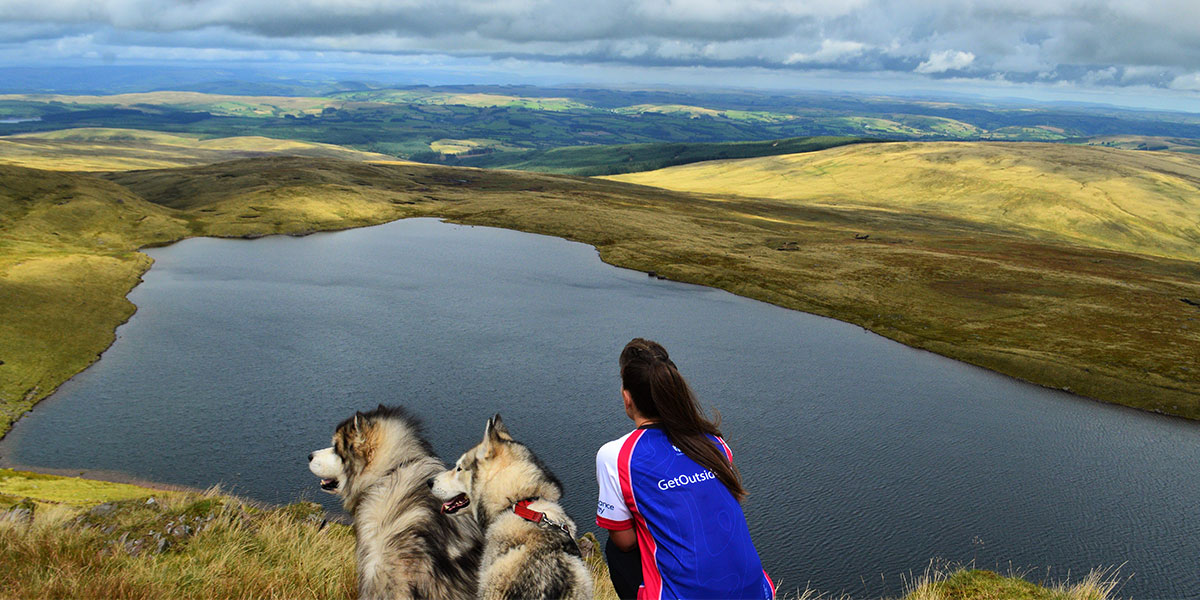

Views across the Black Mountain Range Brecon Beacons National Park
Llyn y Fan Fawr
https://mabinogionastronomy.blogspot.com/2020/07/the-route-of-twrch-trwyth-and-bluestones.html


Now there were less boars, but there were less of Arthur's men, too, many having been lost in the fighting. The Twrch headed right up through what is now Ceredigion, almost to Aberystwyth, and down to Talgarth, with men picking off boars each time. But the Twrch Trwych ran on, through the Tawy Valley to Ewyas Harold, a village in the Golden Valley in Herefordshire, with Arthur's war band constantly hard on their trotters, still seeking the comb, razor and scissors. The great boar was alone now, having lost his sons. As he reached the mouth of the Severn, Arthur leapt upon him. Manawyddan grabbed his feet, upending him into the tidal waters. Then Mabon leaned forward and snatched the razer. Cyledr the Wild wrenched the scissors from between his ears. Before they could get the comb, the Twrch slipped out of Arthur's grasp, shook off his tormentors and scrambled back onto the land. With great speed he fled across the shore towards Cornwall. Undeterred, Arthur pursued him to the Cornish coast where Culhwch seized the comb and tore it from between the ears of the Twrch before the creature fled headlong into the deep sea. He was never seen again.

So Cuhlwch outwits the giant Ysbaddaden, and presents him with the tools to be shaved for the wedding. 

I've found there is great fun and fascinating revelations in trying to trace their devastating path, as all along it, are Neolithic and Bronze Age sites, including stone circles and graves. 

The magical boar can still be seen...


The Stonehenge Mystery of the Altar Stone.


Ten or more years ago, my imagination was captured by the mind-blowing discoveries at the Ness of Brodgar in Orkney, where the archaeological dig had started uncovering this new discovery in a 2010 dig. Brick by brick, bone by bone, they revealed a 5500-year-old temple complex with more than 100 buildings, surrounded by a 10ft wall. Some of this complex is possible more than 800 years earlier than Stonehenge and could be as, if not more, important than the Wiltshire site.


The altar stone lies flat and buried under two fallen sarsen stones
and is barely visible to visitors. 
Photograph: Aberystwyth University


This week's jaw-dropping news about the Altar Stone at Stonehenge changes things again. Scientific research has revealed an extraordinary new mystery––the massive six-tonne stone at the heart of the monument was brought to Stonehenge from the far north of Scotland.


The Altar Stone is ritually the most important stone at Stonehenge. It marks the intersection of the winter solstice sunrise to summer solstice sunset alignment, and the summer solstice sunrise to winter solstice sunset alignment.

Individual crystals were examined which allowed the Altar Stone to be dated, showing Old Red Sandstone from the Orcadian basin in north-east Scotland. This basin was once a massive ancient water body called Lake Orcadie. It's possible that this was already a ritually important stone that  might even have been taken from the Orkney sacred site, or certainly the very north-east area of the mainland. 

Aberystwyth University geologist Nick Pearce
 analyses Neolithic standing stones in Orkney
 
(Prof Richard Bevins, Aberystwyth University)

This journey of over 500 miles seems near impossible. It might have been brought by sea as there is evidence that people at this time were making sea journeys. However, it could have been dragged. That would mean organising teams of people to pull the stone, possibly swapping to new teams as the journey progressed south. But now we are beginning to realise how closely connected settlements might have been, this feels more realistic.

Speaking in the New Scientist,  geologist Richard Bevins from Aberystwyth University said, "Most stone circles are made from rocks found within a kilometre of the site. The thing that’s unique about Stonehenge is the distance that stones have been transported." 

Bevins’s team has already shown that the bluestones come from the Preseli hills in Wales, about 280 kilometres away. One idea is that they were part of an even older Welsh stone monument that was moved, a fascinating story to me, which I featured in this blog post here, because I live so close to these Welsh sites. 

It was always a possibility that early man travelled widely, and the news this week seems to confirm that both these sites were connected. 

An artist's impression of what
archeologists are uncovering

I first wrote about the amazing temple complex at the Ring of Brodgar after Jim and I visited Orkney just as they were starting to dig there. Even then,  it was quite apparent to us  that Orkney was a hub of society at that time, rather than an 'outback'.

You can read more about the full era of the Orkney complex  here on this blogpost, "Unlocking the Secrets of Ancient Worship".

All this linking together of sites across England, Wales and Scotland (as we now think of it), suggests not only hardworking, intelligent and knowledgeable people living in the early Neolithic, but people who could plan, work and worship together. Of course, they may have argued, even fought each other too, but perhaps we might take a lesson from their achievements, which, in comparison, seem to outweigh our own 


Sunday

Bluestone Mysteries: How the Ancestors Honoured these Stones


https://www.wessexarch.co.uk/
our-work/amesbury-arch

Opening a prehistoric grave, finding the skeleton of an ancient person, and sifting through  grave goods, placed with love, at the time of the burial, must be fantastically exciting. Full marks to the way archeologists go about their work nowadays, showing a wide understanding along with a growing respect for the people of the past.


When the Amesbury Archer was uncovered, in 2002, it was described as one of the richest finds in decades. The young man, who died around 2,300BC, was buried three miles from Stonehenge, and a companion (likely a relation), was buried very close. DNA has shown that he'd come from somewhere in what is now Switzerland, and that when he died he might have been in terrible pain for years, from a shattered kneecap and an abscess in his jaw. The idea was posed that such people might have come many miles to Stonehenge, because this was a centre of healing. And this has been reinforced by tiny fragments of stone found among the grave goods, that turn out to be chips of bluestone, possibly left in-situ in pockets or drawstring bags kept near their skin, something that reminds me of the way we love to wear or carry powerfully healing crystals nowadays.


Whatever made these tiny stones so precious and powerful? Maybe the answer is in the story of why bluestones were erected so far away from their origins. 

Carn Meini, the Dragon's Back
For over 1,500 years, sacred (and heavy!) work took place on Salisbury Plain in five constructional stages. That's the equivalent of working on a temple from the time of King Arthur to the present day.
The  bluestones were the third phase of this construction (after building the woodhenge and the earthworks). 

They were sourced from the Preseli Hills (Mynydd Preseli) in west Wales, only half an hour's drive from where I live, but more than 140 miles (225km) away from their resting place. This makes Stonehenge very unusual -– almost all the other stone circles are quarried from fairly local stone. 

There are two of the types of Bluestone present at Stonehenge; dolerite and rhyolite which can be found in three very specific outcrops in the Preseli Hil – Carn Goedog Carn Meini and Craig Rhos-y-felin. I am lucky enough to have been to two of these ancient quarries.


https://blog.stonehenge-stone-circle.co.uk/tag/craig-rhos-y-felin/
Carn Meini is an outcrop of spotted dolerite bluestone rock eroded into jagged shapes, locally called The Dragon’s Back. I've been past these wonderful stones many times, when walking the Golden Roadand when holding rituals at the Gors Fawr stone circle  which stands directly below the outcrop.

Carn Meini has a very strong radiant quality. It’s not surprising the bluestone found there was used and loved so much in the Neolithic. Even so, it is amazing that bluestones found their way from a very powerful and ancient site in Pembrokeshire to another very ancient and powerful site over two hundred miles away, but the truth is stranger even than any fiction by Bernard Cornwell.
Perhaps even more spiritually  energetic and atmospheric is Craig Rhos-y-felin, less than a mile north of Care Meini. The photo shows the excavations that took place a few years ago, by the National Museum Wales. What they found there excited them. Because bluestone outcrops are formed in huge, natural, vertical pillars, they think it would have been possible to break off ‘monolith-sized’ slabs by hammering wooden wedges into cracks and wetting them thoroughly. As the wood swelled, the slab would simply split, ready to be carted away. This would have been equally possible at Carnivore's Meini, but at Rhos-y-felin, these slabs are long and strong, and would make marvellous standing stones for a ritual circle.  

The last time I was there, it was August, and the sun was burning down on us. The sensations that came from the place were sacred and full of old god energy. The fallen stones were as hot to the touch as an iron.The little stream running to the side was clear and cool, and all around it grew wild flowers.  Rare marsh fritillary butterflies were flitting around as if it was just an ordinary day to them, while we were in absolute paradise, gazing up at t
he outcrop as it loomed out of the flat ground like a cathedral. 

I'm pretty sure that this had to be the first sacred place of these early people – think of Ayers Rock in Australia. So, why not take a bit of the sacred away and create a second sacred place? I lay flat on one of the fallen slabs and closed my eyes, sensing the still, silent power of this place. It was a profound experience to journey here, in what felt like a holy sanctuary.

I couldn't help tapping the slabs of rock with smaller pieces of bluestone. Scientists discovered that they give off metallic sounds when tapped. And they are also two to three times more magnetic than most stone. Did early man encounter the dragon of Carn Meini and the towering temple of Rhos-y-felin and discover these magical propensities?

The National Museum of Wales took much evidence away from their dig at this wonderful rock face, including quarrying tools (stone wedges and hammerstones), which confirmed that the site as a Stone Age quarry. Most importantly, hazelnut shells and charcoal from the quarry workers’ campfires have been radiocarbon-dated to reveal proof that people quarried at both sites from around 3400BC.


Professor Mike Parker Pearson (UCL Institute of Archaeology) was puzzled at these early dates “It could have taken those Neolithic stone-draggers nearly 500 years to get them to Stonehenge, but that’s pretty improbable in my view. It’s more likely that the stones were first used in a local monument, somewhere near the quarries, that was then dismantled and dragged off to Wiltshire.”


Parker Pearson looked at the work of Welsh geologist Herbert Thomas, who in 1923 worked out that Stonehenge’s bluestones had been moved to Salisbury Plain by people – not carried, as some had speculated, by Ice Age glaciers. 
Thomas concluded that the bluestones originally formed a “venerated stone circle” somewhere in Wales. To prove this theory,  Parker Pearson needed to find that original site and set about searching for a Welsh stone circle that would conclusively link to the stones on Salisbury Plain.


Waun Mawn
They first looked at Waun Mawn, an arc of stones located just three miles from the quarries There are four remaining stones, one standing and three prostrate and they dismissed the site after a brief survey.

   He says; 'After having no luck with other circular monuments in the area, we returned to Waun Mawn for a final speculative dig.To everyone’s delight, our dig supervisor Dave Shaw discovered two empty stoneholes, one on each end of the arc of stones, where missing stones had once stood. Subsequent digs unearthed further stoneholes, arranged in a circle with an identical diameter to Stonehenge’s enclosing ditch.'

The next link in this chain of bluestone mysteries, would be to date these holes to find out when the bluestones were at Waun Mawn. Their erection and dismantlement turned out to be in the middle to latter part of the fourth millennium BC. This means there was a circle here, and it was constructed before the initial construction of Stonehenge.


'Most strikingly,' Parker Pearson revealed, 'we also discovered a stone chip in one of the stoneholes at Waun Mawn, which must have become detached from the bluestone pillar that originally stood there. It was confirmed as unspotted dolerite, a rock type represented by three stones at Stonehenge.


One exceptionally clear imprint  showed an unusual pentagonal cross-section. A computerised model of the Waun Mawn imprint and Stone 62 at Stonehenge showed that they fitted together perfectly: like a key in a lock.


The new discoveries also cast doubt on a popular theory that the bluestones were transported by sea to Stonehenge – taken southwards to Milford Haven, paddled up the Bristol Channel and along the Bristol Avon towards Salisbury Plain. But these quarries are on the north side of the Preseli hills, so the megaliths could have gone overland to Salisbury Plain. 


 But why would these stones be moved?

Posthole map


  I  think this might have to be to do with the

   Amesbury Archer, a young, sick man from

     Europe,  and the chip of bluestone found 

   in his pocket.   

   Ancient man may not have had Facebook, 

      but they were communicating; sharing. 

  engineering, astrological and scientific  

   knowledge, and also taking more deeply,

    about  spirituality, about shamanic

 experiences, about ancestors, and about

   the power of the naturally world. 


As someone who uses shamanic techniques in their day-to-day life, I know the importance of working with, and honouring, our ancestors. As a Druid, I'd say it is one of the main aspects of Druidry. But we shouldn't forget that the ancestors also honoured their ancestors; and within the hundreds of years that bluestone circle at Waun Man stood, and was ritually used, by those living around the Preseli Hills, those people had become the honoured dead to others around the British Isles; and beyond. It is unlikely we will every know why one circle was brought to another woodhenge, but what is clear is that now –– today in 2024 we can honour that, and bring those feelings of sacred work into our own lives. 


As ever your thoughts and comments are gratefully received.

You can watch the programme BBC TWO made on the finding of the original bluestone circle here

Tuesday

Celebrating Samhuin; Through the Gates of Annwn

         Gwyn ap Nudd: Wild God of Faerie, Guardian of Annwfn - Watkins MIND ... www.watkinsmagazine.com       

Winter looms on the horizon, the Wheel of the Year turns once more, the boundary between our world and the spirit world is fragile and thin. In cultures all over the world, the spirit of Death has been celebrated at this time of the year. 

How do you celebrate Hallowe'en, the night of all souls, which the Irish call Samhuin, and the Welsh call Calan Gaeaf?

 Is it for you a chance to move through the veil between the worlds and communicate with those you loved, and have lost in this world? 

Or is it a chance to drum into trance and search for ancestor wisdom?

Or do you search for the gods and goddesses who are associated with death and darkness, such as Gwyn ap Nudd, Arawn, Hecate, the Morrighan, Anubis and Osiris, Hades, and, of course Hel, daughter of Loki, with her bones on the outside of her body, portrayed in black and white,

Do you avoid it altogether, as a time when death is abroad and best avoided?

Or do you just think that we imagine such things, and make it all up, as the darkness descends at this time of year, that silly idea of a thinning of a veil between worlds, and that other being can contact humans at these times?

Certain, we must surely agree that somewhere in all the ancient myths there are acorns of truth. The last time I was in Ireland, my taxi driver explained, as we passed a fairy hill, that the Sidhe lived beneath it, and that the farmer would never drive a tractor across it. 

The  otherworld had many names across the world we now think of as Celtic, including Tir-na-nog, the land of Youth, Tir-Innambeo, The Land of the Living, Tir- Tairngire, The Land of Promise, Tir N-aill, the Other World, Mag More, The Great Plain,  The Isle of Women, Isle of Apples. This otherworld was located quite far away, over sea or though mist, or deep below the ground. It was thought of as a world of peace, harmony and abundance, where no ailment or death could be found. Hy-Brasil (from Gaelic, “Isle of the Blessed”) was an “enchanted island“ off the coast of Ireland – seen by many people over a thousand years, but never remaining in one location, it then disappeared from maps completely. 

In The Adventure of Bran,  Son of Febal from the seventh century, Bran travels to Hy-Brasil a paradise supported on golden pillars. No one is ever sad or ill there; they are always happy, continually playing games to musical accompaniment. When early sailors crossed the Atlantic and landed on the coast of South America, they imagined they had found Hy-Brasil at last, and that country is called Brasil to this day.

I'm not sure we do need to wait until Samhuin to contact the ancestors, though. In lockdown, we did a summer outdoor ritual which focused on those relations recently passed; our parents, our grandparents and their parents. Read it here.

There is another side to Samhuin, which is to explore, in this winter darkness, our own weaknesses and difficulties. Often, this is harder than speaking to loved ones who have passed into the next life. Old wounds might be ignored in the busy light of day, but in candlelight on the 31st of October, when the veil is thin, they confront us, allowing us to pass over normal boundaries and examine our human condition in the raw. These wounds, personal, family, historic or from a wider experience, can be forceful, they can create a disconnect, they can chip away at our soul, and destroy our enjoyment of life. They can obstruct us, actually create a spiral where we can't heal them because the wounds prevent that healing.  Going on such a journey at Samhiun, meeting ones otherworldly allies and speaking honestly with our guides and guardians can help reverse this spiral.

The Spoils of Annwn is an ancient Welsh myth that tells of a heroic journey of King Arther and a group of warriors. They take their ship Prydwen (wen means white, pure, or blessed) on a perilous voyage into the otherworld. They visit seven different forts on seven otherworldly islands in search of a magical cauldron. 

My first words were spoken concerning the cauldron: from the breath of nine maidens it is warmed. It is the cauldron of the Head of Annwfn; what is its purpose with its dark rim and edged with pearls? It will not boil the food of a coward; it is not destined to do so.

This poem was written down in the fourteenth-century Llyfr Taliesin (Book of Taliesin)  It is hauntingly beautiful, There is a translation of this poem in Robert Graves' The White Goddess.

 It can be used to create ritual, or it can be use to access a shamanic journey. Studying it closely brings it alive. To me, this white ship is a trancelike journey to meet ancestors and learn from them, while also learning more about one's "self", and one's "life journey". In ritual, we can visit each castle or 'Caer' and look at them from whatever approach we need on our journey; maybe aspects of our characters, or goals to drive towards, or weaknesses we'd like to be strong about removing from our lives.

One thing is clear though, it's not a place for the fainthearted. The texts reminds us constantly that; And when we went with Arthur,/   dolorous visit, / except seven/    none rose up.  Other translations say ...none returned.

Stay safe in ritual by laying down ground rules with the other ritualists, and discussing the ideas beforehand. Stay safe when journeying by knowing you can return to your 'home space' the chosen place that should start and end a journey, and by calling your animal allies to you to accompany you and guide you on your way...and on your way back. 


Sunday

THE MYSTERY OF PAVILAND CAVES: AN ANCIENT SHAMAN OF WALES


an artistic representation of the buriel of the 'red lady'

I like to believe that right here within the British Isles, we have traditions in shamanic work that go back as far as the very first people to walk these lands…and that’s long before the British Isles were disconnected from mainland Europe. One of the things I love to do is listen to the land to hear the story our ancestors have left us. Like many others, I’m searching for a personal understanding of how the ancient people accessed and used the same spirit world I’m able to ‘walk’ into today. 
In Britain, we hold one of the most wonderful discoveries demonstrating just how spiritual these ancient people were – the oldest known ceremonial burial site yet found in Western Europe.

Just under 200 years ago, a doctor called John Davies was exploring the cliffs near Worm’s Head on the Gower in South Wales. He climbed up to a small cave called Goat Hole, where he came across a skeleton. He quickly informed his friend William Buckland, an Oxford professor, who thought himself to be an expert on such things. He came to have a look at the bones in the cave, afterwards writing a description…

”I found the skeleton enveloped by a coating of a kind of ruddle…which stained the earth, and in some parts extended itself to the distance of about half an inch around the surface of the bones ... Close to that part of the thigh bone where the pocket is usually worn surrounded also by ruddle, about two handfuls of the Nerita littoralis [periwinkle shells]. At another part of the skeleton, viz in contact with the ribs, forty or fifty fragments of ivory rods, some small fragments of rings made of the same ivory and found with the rods ... Both rods and rings, as well as the Nerite shells, were stained superficially with red, and lay in the same red substance that enveloped the bones."

Early photo of William Buckland
Buckland believed this to be a Roman prostitute, which he named the ‘Red Lady of Paviland’ because of the ‘ruddle’ (actually a red ochre powder), covering the body, now known to have had huge significance in early times. Buckland assumed a red burial meant ‘profane’. It actually meant ‘sacred’ to the people who used it.

Buckland was also wildly in error over the age and sex of the remains. This person wasn’t Roman, but rather, the earliest Homo Sapiens skeleton we have ever found in the UK. And although still affectionally called the Red Lady, he was a tall, slender man in his early twenties.

Buried with him were shell necklaces, flints, stone needles and animal bones, including a mammoth’s skull. But most important of all, for me, are the mammoth ivory ‘rods’. These seem to be fragments of a beautifully carved wand. They were found together over his ribs, suggesting that this wand, ritually snapped into pieces during the burial ceremony and placed over his heart, was a shamanic tool.

Because of Buckland’s misunderstanding of the importance of the find, we’ve lost quite a lot of the remains,  including the mammoth skull, which went missing in the nineteenth century. However, the human skull was missing even at that earliest point and no one can work out whether it was simply taken by animals or if there is a more interesting reason for its absence. I cannot help linking this man’s sacred interment minus his head with the wonderful story of Bran’s oracular head, as told in the second branch of the Mabinogion, an early Welsh myth. 

I’ve been to the Goat Hole, where the Red Lady was found. To reach it we scrambled from the farmland above the cliffs down a gully towards the sea. Pink and yellow tufts of flowers grow out of the cliffside and there’s a constant sound of water trickling, accompanied by the gulls and the shush of distant waves. But the gully is rightly named ‘the devil’s path’. It is steep and difficult. If you don’t watch your footing, you can slip on scree as precarious as ball bearings, or twist an ankle on the loose and wobbly boulders.


Towards the bottom, the path narrows to a foot’s width, leading to a drop, the height of a man, onto the flat slabs of rock below. Here, the wind comes off the sea with a fast, sharp edge. Even at the vernal equinox, the tide is relentless, giving you bare hours to explore. The flat limestone expanse also needs care – it’s a mass of razor edges, like the sharp scales of some marooned sea-monster, ready to cut hands or knees. Between each slab there are gaps as wide as a stride. But it’s worth the risk of a scraped knee, because the rock pools are wonderful, a miniature world of sea creatures with seaweed resembling fresh lettuce and woodland ferns. We were on the coast of the Bristol Channel, but when the Red Lady was put to rest, his grave would have been 70 miles inland, overlooking a plain ripe for hunting and gathering, and, with a bit of a trek, fishing.

To reach the Goat Hole, we had to scuttle straight up the cliff side. There were ten of us on this outing, and we managed to squash into the cave together. We wanted to honour what happened here thirty-thousand years ago.

One of our party lay in the cot-like area where the Red Lady had been found. In the half-light, her still and silent body transformed for us, and we were able to step back in time. I was easily welcomed into the otherworld. The rocks were resonating with energy – I could palpably sense the spirit of the cave. Quietly, each of us stored our own impressions.

At the bottom of the cliff, at sea level, is a larger, more geologically impressive cave. We called it ‘the womb’, because of its internal structure and the tenor of our journey within it. The cave mouth gapes as you walk to it, but from a distance, it’s very like a woman’s vulva.

At the mouth of the cave, we all took off our clothes, leaving them folded in a dry spot. If we were to go into a womb as hallowed as this, we wanted to do it in full, natural reverence, as children of the earth. 

The first chamber is elongated with an uneven floor and a raised ledge to one side that leads away into darkness. One by one, we crawled onto this narrow ledge. Its outer edge was rounded and slippy, and a slick coat of slime and seawater, as precarious as wet ice, covered both ledge and wall. Below, the lower level was deep in icy water, trapped after the tide’s retreat. We inched our way in, unable to grip anywhere or trust the next move.

Some of us walked upright, but at a wearisome pace. Most of us, including me, crawled steadily away from daylight. Each movement seemed to take me an hour, as if my muscles were being glued together, and all the while, the booming waves echoed in my head. I crawled on and on, my knees and palms sliding against what felt like the very mucous membrane of the cave, until all light was lost. I was like a child in a dream, letting the earth take me into itself.

The middle section of the cave forms an hourglass, which opens into the final chamber, the rounded womb of the cave. The air here was chilled with an edge of salt, but it was slightly higher ground, with a dry shingle floor which was comforting for our bare feet. The place certainly felt like a place of safe lodging after a hard journey. There was total darkness this deep into the rock, but if we stood directly under a certain spot we could perceive at a far distance, a circle of dull light. At first I thought it was a crystal, embedded in the roof of the cave, but then I realised. It was a funnel, leading to the clifftop. 

We held hands in silence. Quite naturally, we began to chant, some singing tunelessly. This went on for a long time, until we left the perceived world altogether. As we finally came back into normal reality, one of our number exclaimed. “something’s cutting into my foot.” He bend to retrieve the item, and held it all through the perilous journey into the light. The thought in our heads, as we returned from the deeply profound moments together in the womb cave, was that of birthing, of coming out into a space newly transformed. I was sure we would all see the apparent world differently now.

Selection of found prehistoric flints
After we’d pulled our clothes over damp skin, we examined what our friend had brought out of the womb cave. It was a spear tip, perfectly knapped in flint. A gift from the spirits of Paviland, who have watched over the dead and the living for eons. 

We picnicked right there on the lip of the cave, looking out over the Bristol Channel.  The sea was like a steel mirror. A small fishing boat passed off shore and someone waved. We all waved in turn. 

 Later, back home, as dusk fell, we enacted the death of the priest-shaman, imagining how, as he was dying, he might have passed on his gifts to certain among his people, telling them which of his sacred artefacts were to be interned with him. We dramatised his burial, each playing our part, feeling our way back to bereavement 32,000 B.C.E. 

Finally, we journeyed individually to the beat of a single drum. In my journey, I returned to the Goat Hole. On my climb up the cliffside, I passed an elf-like creature who beckoned to me. But my spirit ally warned that this was a tricksy spirit and to keep journeying onwards. I finally reach the cave and ducked inside. There, sitting just where the light fell upon him, was a colourful figure, rather like a jester, who described himself as the Story Maker. He asked me to document my time at Paviland, and what it meant to me. 

When I returned, I furiously wrote a description of both my journey with the drum, and our physical journey earlier that day. The Story Maker had compelled me to think again just how essential this was. As I wrote, the entire day became more and more real to me, as if I was living it through again, in even more ‘mindfulness’ than I’d had at the time. When you’re travelling in a group, you’re bound to become one of them in so many ways…concerned for anyone who’s finding it tough…laughing at someone’s clever quip. But during my shamanic journey up the cliff and into Goat's Hole, I was alone, and every sensation, internal and external, was acute.

The writing made an internal shudder pass through me. I had been to the place where, over 30,000 years ago, people had buried, with honour and dignity, and in the presence of spirits they had called as witnesses, an early shaman of Britain. I feel honoured to have been part of that continued rediscovery.


A version of this blog first appeared in Indie Shaman Magazine in 2017 https://indieshaman.co.uk